
Part 5 General Regulations
5.1. Accessory Buildings
5.1.1. An accessory building shall not:
(a) be approved or developed on a parcel prior to the development of the principal building or use on the parcel;
(b) be used as a dwelling unit unless approved as a secondary suite or a security suite; and,
(c) be located in a front yard in a residential district in the Urban Service Area.
5.1.2. In a residential district, the maximum lot coverage for all accessory buildings on a lot shall be:
(a) within the Urban Service Area, fifteen percent (15%) of the lot area to a maximum of 100.0sq m, whichever is lesser;
(b) in all other residential districts fifteen percent (15%) of the lot area to a maximum of:
i. 250.0sq m for parcels under 0.7ha; or,
ii. 350.0sq m for parcels 0.7ha and larger
whichever is lesser.
5.1.3. In all districts, accessory buildings are subject to the side yard setback and rear yard setback provisions of that district, with the following exceptions:
(a) in all residential districts in the urban service area, an accessory building shall be setback a minimum of 1.0m from the side and rear lot lines;
(b) a detached garage with its vehicle door facing the lane in which case a rear yard setback of either 1.0m or 6.0m is required. However, lots with a 1.0m utility right of way in the rear yard must have a minimum rear yard setback of 1.0m up to a maximum of 2.0m so that the garage eave does not encroach the utility right of way;
(c) a mutual garage erected on a common lot line, in which case the side yard setback may be reduced to zero, provided the common wall is a firewall;
(d) an accessory building of less than 2.0m in height, in which case the side yard setback and rear yard setback may be reduced to zero; and,
(e) an accessory building located on a corner lot, in which case a minimum exterior side yard setback of 3.0m is required from the lot line abutting the road that is not a lane.
5.1.4. Where vehicular access to a detached garage is from a street, there shall be a minimum front yard setback of 6.0m.
5.1.5. Maximum height restrictions for accessory buildings are as follows:
(a) 4.6m in all residential districts within the Urban Service Area, except in the case of a detached garage suite;
(b) 4.6m in all residential districts within the Rural Service Area on lots smaller than 0.405ha;
(c) 7.0m in all residential districts within the Rural Service Area on lots 0.405ha or larger; and,
(d) in all other districts, as specified by the site provisions for the district.
5.1.6. An accessory building shall be located a minimum of 1.0m from the principal building on a lot.
5.1.7. Not withstanding Part 5, Section 5.1.6, where there is rear lane access, there will be a minimum separation distance of 4.6m between the principal building and the detached garage.
5.1.8. An accessory building on a lot in a residential district shall be similar and complement the principal building in appearance such as, but not limited to, roof design, exterior material, appearance, and colour.
5.1.9. Where amenity space including but not limited to decks, balconies, and sunrooms is proposed for an accessory building the setbacks for a principal building in that district shall apply.
5.1.10. When an accessory building is a sea-can, the following shall apply:
(a) Sea-cans are not allowed in the Urban Service Area except in institutional districts and in industrial districts.
(b) Sea-cans located in industrial districts and institutional districts are a discretionary use and shall be screened from any roads to the satisfaction of the Development Authority.
(c) Sea-cans are a discretionary use in the Rural Service Area and shall be screened from any roads to the satisfaction of the Development Authority.
(d) The Development Authority may require a sea-can be similar to and complement the principal building in exterior material, colour and appearance.
(e) Sea-cans shall not be unsightly and shall be finished to the satisfaction of the Development Authority.
5.1.11. When an accessory building is a quonset, the following applies:
(a) A quonset is a discretionary use in the following districts:
i. Light Industrial District;
ii. Medium Industrial District;
iii. Heavy Industrial District;
iv. Public Service District;
v. Airport District;
vi. Urban Expansion District; and
vii. Rural District.
(b) A quonset shall only be approved for storage use.
5.2. Active Frontage
5.2.1. Where the at-grade level of an apartment is developed with a non-residential use:
(a) For buildings adjacent to a road, the primary entry door to each unit shall be provided from the building façade adjacent to the road.
(b) The front yard setback may be used for commercial uses including but not limited to patios or retail spill-out.
(c) For buildings on corner lots, the building façade facing a road shall be activated using elements such as but not limited to windows, entry doors, patios, awnings and architectural features.
(d) Transparent windows and doors shall be provided along a minimum of twenty percent (20%) of the at-grade building façade.
5.2.2. The at-grade storey shall have a minimum vertical distance of at least 4.5m.
5.2.3. An additional entry door shall be provided where there is a rear parking area.
5.2.4. There shall be a minimum 2.5m barrier free sidewalk along the frontage facing the public streets.
5.3. Adult Entertainment Facility
5.3.1. A development permit for an adult entertainment facility shall not be approved within:
(a) 150m from the boundary of a residential district;
(b) 150m from a lot containing a dwelling unit within a commercial district;
(c) 150m from a lot containing a child care facility, recreation facility, indoor, elementary school, junior high school, high school, or religious assembly; or,
(d) 150m from any other adult entertainment facility.
5.4. Agricultural Uses
5.4.1. Fencing, screening or other forms of spatial separation shall be provided to the satisfaction of the Development Authority to:
(a) ensure the on-site confinement of animals; and
(b) to reduce noise or visual impact on surrounding properties.
5.4.2. Pigeons are not permitted in any land use district unless the person keeping them is in good standing with the Canadian Racing Pigeon Club or the Canadian Pigeons Fanciers association and the birds are banded with a seamless association band on their leg.
5.4.3. Wild boars are not permitted to be kept in any land use district.
5.4.4. Manure or any manure by-product shall be managed to limit manure runoff onto adjacent lands or to a waterbody to the satisfaction of both the Development Authority and the Regional Health Authority.
5.4.5. Any animal lodgings shall be constructed above the 250.9m elevation. Grazing or fenced areas may be permitted below the 250.9m elevation.
5.4.6. Animal lodgings, grazing areas and manure storage areas shall be setback a minimum of:
(a) 15.0m from the side and/or rear yard property lines for lots that are 0.404ha to 2.0ha
(b) 30.0m from the side and/or rear yard property line for lots that are over 2.0ha.
5.4.7. Birds and animals, including livestock, not listed under Part 5 Section 5.4.8 or Part 5 Section 5.4.10 are at the discretion of the Development Authority.
5.4.8. The following provisions apply to agriculture, off-site sales and agriculture, small scale:
(a) The keeping of birds and animals, including livestock, shall be limited to two animal units per acre (0.404ha).
(b) For the purposes of this Part 5 Section 5.4.8, “one animal or bird unit” means:
| Type of Animal | Number of Animals Equivalent to One Unit |
| N. American bison | 0.5 |
| Horse, donkey, mule, elk, cattle or hog | 1 |
| Goats, sheep, llamas, alpacas, ostriches or emus | 2 |
| Deer | 3 |
| Ducks, geese, pheasants, turkeys, chickens, pigeons, rabbits, chinchillas or mink | 10 |
5.4.9. Agriculture off-site sales shall be limited to a maximum of three (3) employees that provide services in addition to the permanent resident(s) of the property.
5.4.10. The following provisions apply to agriculture, personal use:
(a) The keeping of birds and animals, including livestock, shall be limited to two animal units per acre (0.404ha).
(b) For the purposes of this Part 5 Section 5.4.10 and Part 5 Section 5.4.12 (a), “one animal or bird unit” means:
| Type of Animal | Number of Animals Equivalent to One Unit |
| Horse, donkey, mule or hog | 1 |
| Goats, sheep, llamas, alpacas, ostriches or emus | 2 |
| Ducks, geese, pheasants, turkeys, chickens, rabbits or chinchillas | 5 |
5.4.11. No livestock, fowl, or fur-bearing animals, other than domestic pets, shall be permitted in any residential district in the Urban Service Area.
(a) Despite Part 5 Section 5.4.11, hens, as defined by the Backyard Hen Bylaw shall be permitted in the Municipality subject to compliance with the Backyard Hen Bylaw.
5.4.12. Despite Part 5 Section 5.4.10, in rural residential districts in Saprae Creek Estates, Conklin, Janvier, Anzac and Draper:
(a) Horses, donkeys, goats, llamas, alpacas, and other similar animals may be kept as pets and/ or for personal enjoyment and shall be limited to two (2) animal units for the first acre (0.404ha). In addition, one 1 animal unit may be allowed for every additional acre (0.404ha) up to a maximum of 10 animal units.
(b) Additionally, within the above named hamlets, animals in rural residential districts must be confined within a fence constructed to the satisfaction of the Development Authority.
5.5. Amenity Area
5.5.1. Amenity areas are a common or private indoor or outdoor area provided for active or passive recreation and enjoyment of the occupants of a residential development and their guests.
5.5.2. Multi-unit dwellings and apartments shall provide amenity areas as shown below:
| Typology | Private amenity area per unit (minimum) | Common amenity area per unit (minimum | |
| Indoor | Outdoor | ||
| Multi-unit dwelling | 6.0sq m | None | 10% of lot area |
| Apartment (less than 50 dwelling units) | 4.0sq m |
2.5sq m May be added to outdoor common amenity area or private amenity area or both |
1.0sq m |
| Apartment | 4.0sq m | 2.5sq m | 1.0sq m |
5.5.3. Private amenity area:
(a) shall be provided in the form of at-grade patios, balconies or roof terraces for a dwelling unit, and shall be adjacent to, and with direct access from the dwelling unit;
(b) shall include visual cues including but not limited to, fencing, railing, or signage to indicate the space is private;
(c) shall have a minimum width of 2.0m and minimum length of 2.0m; and,
(d) may be located within the required separation space.
5.5.4. Common amenity area:
(a) when provided indoors, shall be separate from a building’s common public areas (e.g. lobbies, elevator, stairs, corridors, and vestibules);
(b) when provided outdoors:
i. a playground with play structure shall be provided for apartments or multi-residential developments with fifty (50) or more dwelling units;
ii. may consist of a single, distinct use area or be divided into multiple use areas, but shall not be less than 25.0sq m for at least one (1) distinct use area;
iii. shall be designed with privacy screening when in the form of a rooftop terrace;
iv. when provided in an apartment that also includes non-residential uses, shall be visually screened from the non-residential uses on the site and shall only be accessible to residents of the development.
5.5.5. When a parcel containing a public park is located within 200m of the nearest building footprint of the development and is not separated from the development by an arterial road, no outdoor common amenity area is required.
5.6. Architectural Elements
5.6.1. Architectural elements are encouraged, in particular along building frontages, in order to create distinct and visually interesting building design. Architectural elements may include but are not limited to eaves, balconies and porches, cornices, ornaments, canopies, bay windows, and stairs.
5.6.2. The design, character, external finish, and architectural appearance of all buildings, including accessory buildings shall be to the satisfaction of the Development Authority.
5.6.3. Building façades adjacent to roads or public open space shall be designed to ensure they are visually interesting through the utilization of windows, doorways, articulation, architectural elements and/or building materials.
5.7. Bed and Breakfast
5.7.1. A bed and breakfast is an accessory use, where the principal use shall be a single detached dwelling.
5.7.2. A bed and breakfast shall not be developed on the same lot as a boarding house, secondary suite, child care facility, live-work unit or home business, major.
5.7.3. A bed and breakfast shall be operated by the permanent resident(s) of the single detached dwelling. There shall not be more than one (1) non-resident employee on the development at any time.
5.7.4. One (1) non-illuminated sign or plaque may be permitted on a building in urban and hamlet residential districts. The maximum sign or plaque dimensions shall be 0.3m by 0.5m.
5.7.5. For bed and breakfast in all rural districts other than hamlet residential, one (1) identification sign to a maximum size of 0.4sq m and 1.2m in height is required.
5.7.6. A maximum of two (2) bedrooms per single detached dwelling shall be permitted as guest sleeping units, except:
(a) in rural residential districts, an additional two (2) bedrooms may be permitted as guest sleeping units at the discretion of the Development Authority; and,
(b) in the Rural District, an additional four (4) bedrooms may be permitted as guest sleeping units.
5.8. Boarding House
5.8.1. A boarding house:
(a) shall only be within a single detached dwelling located on a corner lot;
(b) shall not be developed on the same lot as a bed and breakfast, secondary suite, child care facility, or home business, major;
(c) shall contain no more than five (5) sleeping units.
5.9. Building Separation Requirements
5.9.1. In the case of apartment or tower developments adjacent to each other on the same lot or block, the following building separation distances shall apply:
(a) Any portion of a building over 32.0m in height shall be separated by not less than 25.0m measured horizontally from any part of another building 32.0m in height or more.
5.10. Campgrounds
5.10.1. General Requirements
(a) Mobile homes are not permitted in a campground except as provided in Part 5 Section 5.10.8 (c).
(b) Accessory buildings, additions or decks ancillary to a recreational vehicle or within a recreational vehicle stall are not permitted.
(c) Only commercially designed and manufactured skirting is permitted on recreational vehicles.
(d) Recreational vehicles are only permitted in recreational vehicle stalls.
(e) Campground design and maintenance shall incorporate FireSmart principles.
(f) Animal proof garbage cans shall be provided throughout the campground.
5.10.2. The campground plan design shall incorporate and promote the following features:
(a) the conservation and management of habitat, waterbodies, wetlands, and steep slopes;
(b) existing clearing and open areas; and,
(c) connectivity within and between natural habitat systems and areas.
5.10.3. Campground amenity space
(a) A minimum of five percent (5%) of the total area of the campground shall be provided as campground amenity space.
(b) For campgrounds without year-round accommodation of recreational vehicles, tent camping is not permitted in the campground amenity space.
(c) For campgrounds consisting of more than twenty (20) recreational vehicle stalls, a play structure shall be provided in the campground amenity space.
5.10.4. Recreational Vehicle Stall Requirements
(a) For campgrounds with year-round accommodation of recreational vehicles, the minimum stall size shall be:
i. width: 6.0m;
ii. length: 16.0m.
(b) Stalls proposed for year-round use shall be hard surfaced to the satisfaction of the Development Authority.
(c) Site amenities for each stall shall include a cleared 8.0sq m amenity area with a picnic table.
(d) A 2.0m minimum landscaped buffer shall be provided between recreational vehicle stalls.
5.10.5. Fences and Stall Boundaries
(a) Fences shall not exceed 1.2m in height.
(b) Fences shall be uniform in design and maintained in a safe and attractive condition by the campground operator throughout the site.
(c) All stalls shall be clearly identified with a stall number.
(d) All stall boundaries shall be visible and clearly defined.
5.10.6. Transportation & Pedestrian Circulation
(a) All roads provided within the campground shall be developed to Engineering Servicing Standards designated for the rural area.
(b) Campgrounds with year-round accommodation of recreational vehicles proposed to be open year-round shall maintain internal roadways year-round.
(c) Municipal roads leading to a campground must be brought by the applicant to a condition capable of sustaining the volume and type of traffic to be generated by the proposed campground.
(d) Interior signage, such as clearly marked egress routes, wayfinding or stop signs, shall be installed to the satisfaction of the Development Authority.
(e) Campgrounds consisting of more than twenty (20) recreational vehicle stalls shall display a permanent stall location map at the entrance to the campground.
(f) Pedestrian circulation routes to public facilities and major recreational activity areas must be provided. Walking trails shall be provided as alternatives to the main campground road.
(g) Regulatory signage must be installed as per Engineering Servicing Standards.
5.10.7. Utility Services Requirements
(a) Sewage disposal systems, potable water holding tanks, and electrical servicing shall meet all applicable provincial and federal regulations.
(b) Utility and telecommunication services shall be located below ground.
(c) For campgrounds with year-round accommodation of recreational vehicles, a winterized sewage disposal facility (dump station) shall be provided that is easily accessible and separated from the recreational vehicle stalls and amenity spaces.
(d) For campgrounds with year-round accommodation of recreational vehicles, electrical services shall be provided in all stalls and be a minimum 30 amperes service.
(e) Washroom facilities shall be provided in centralized locations.
5.10.8. Safety
(a) The owner of a campground shall develop and post a fire safety plan and have fire preparedness and suppression equipment in place to the satisfaction of the Development Authority.
(b) A minimum thirty (30) metre natural/landscaped buffer around the boundary of the campground must be provided and maintained to the satisfaction of the Development Authority. The applicant in its submission shall identify and provide justification for any deviations or non-conformance to the standards sought by the applicant.
(c) For any campground containing twenty (20) or more recreational vehicle stalls, a security residence located at the main entrance to the campground may be approved.
5.10.9. Accessory Developments
(a) The location, design standards and site requirements of any developments, uses and services such as decks, recreational buildings, equipment storage facilities, fire pits, cook shacks, fire wood storage and any other similar uses or services that may be associated with or required within a campground may be approved at the discretion of the Development Authority.
5.10.10. Notwithstanding the above in Part 5 Section 5.10, the applicant shall in its submission, identify and provide justification for any deviations or non-conformances sought in the application of the Engineering Servicing Standards.
5.11. Cannabis for Personal Use
5.11.1. In a single detached dwelling, semi-detached dwelling, mobile home, duplex, secondary suite, and multi-unit dwelling, up to four (4) cannabis plants may be grown inside the dwelling, accessory building or in a fenced rear yard where the fence provides visual screening of not less than 2.0m.
5.11.2. In apartments, up to four (4) cannabis plants may only be grown within the dwelling unit.
5.12. Cannabis Production and Distribution Facility
5.12.1. Separation Distance
(a) A lot containing a cannabis production and distribution facility shall be located no less than 300m away from the boundary of a lot that is used for one (1) or more of the following:
i. elementary school;
ii. junior high school;
iii. high school;
iv. college;
v. hospital;
vi. child care facility;
vii. alcohol and drug rehabilitation centre; and,
viii. residential building.
5.13. Cannabis Retail Store
5.13.1. Separation Distance
(a) A lot containing a cannabis retail store in the Urban Service Area shall be located no less than 150m from the boundary of a lot that is used for one (1) or more of the following:
i. elementary school;
ii. junior high school;
iii. high school;
iv. college;
v. hospital;
vi. child care facility; and,
vii. alcohol and drug rehabilitation centre.
(b) A lot containing a cannabis retail store in the Rural Service Area and hamlets shall be located no less than 100m away from the boundary of a lot that is used for one (1) or more of the following:
i. elementary school;
ii. junior high school;
iii. high school; and,
iv. park.
5.13.2. A cannabis retail store shall not be located on a lot abutting an existing lot that is being used for residential purposes on its ground floor but may be allowed on the ground floor of an apartment.
5.14. Child Care Facility
5.14.1. A dwelling unit developed as a child care facility shall not change the existing building style and remain consistent with the existing character of the street.
5.14.2. A child care facility shall not be developed on the same lot as a bed and breakfast, boarding house, secondary suite, live-work unit, or home business, major.
5.14.3. A child care facility shall provide a fenced outdoor play space.
5.14.4. A development permit for a child care facility shall specify:
(a) the total occupancy, including children and staff; and,
(b) the location of on-site parking stalls for passenger drop-off.
5.15. Compliance Certificate
5.15.1. An owner or a person with legal or equitable interest in a parcel, may, upon payment of the required fee, apply for a compliance certificate.
5.15.2. An application for a compliance certificate shall consist of:
(a) a current certificate of title for the parcel; and,
(b) a real property report prepared by an Alberta Land Surveyor not older than one (1) year prior to the date of application or up to three (3) years prior to the date of application accompanied by a statutory declaration confirming there are no changes or alterations from the condition shown on the attached real property report.
5.15.3. A compliance certificate may be issued when the buildings as shown on the real property report provided by the applicant are located on the parcel in accordance with either:
(a) the provisions of this Bylaw; or,
(b) those specified in any development permit.
5.16. Corner Lot Restrictions
5.16.1. The provisions of this Part 5 Section 5.16 shall not apply to development within the CBD1 – Central Business District, BOR1 – Borealis, and SCL1 – Snyeside/Clearwater Core, and SCL2 – Snyside/Clearwater High Density districts.
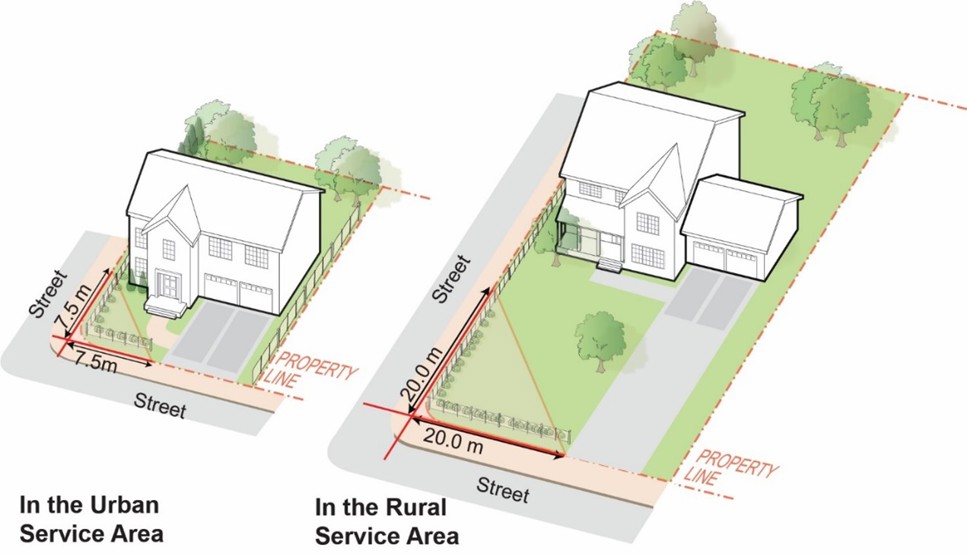
5.16.2. On a corner lot in the Urban Service Area, no fence, wall, tree, hedge or other structure exceeding 0.6m in height above grade shall be permitted in a corner visibility triangle created by the lot lines and a straight line which intersects them 7.5m from the corner where they meet (see Figure 5.1 Corner Lot Restrictions).
5.16.3. Despite Part 5 Section 5.16.2, in the case of a structure that exceeds two (2) storeys, the visibility triangle is only required from grade to the ceiling of the second storey.
5.16.4. On a corner lot within the Rural Service Area, no fence, wall, tree, hedge or other structure exceeding 0.8m in height above grade shall be permitted in a corner visibility triangle created by the lot lines and a straight line which intersects them 20.0m from the corner where they meet (see Figure 5.1 Corner Lot Restrictions).
5.16.5. Despite Part 5 Section 5.16.4, on Rural Service Area lots the Development Authority may grant a variance to allow a reduction in the corner visibility triangle requirement to a minimum of 7.5m where the lot size and configuration are such that traffic and pedestrian safety will not be compromised by such a reduction.
5.16.6. In the Urban Service Area where a lane intersects with another lane or street, a corner visibility triangle created by the lot lines and a straight line which intersects them 4.0m from the corner where they meet shall be provided. No fence, wall, tree, hedge or other structure exceeding 0.6m in height above grade shall be permitted in a corner visibility triangle.
5.17. Decks
5.17.1. A deck shall:
(a) not project into the required front yard setback;
(b) not exceed the height of the ground floor level of the principal building;
(c) be setback a minimum of 1.0m from the interior side lot line and all accessory buildings;
(d) where there is no lane adjacent to the lot and where there is no front attached garage, be setback 2.8m from an interior side lot line to allow for vehicle access to the rear yard when there is a detached garage on the lot;
(e) be setback a minimum of 3.0m from the exterior side lot line;
(f) not be located within the corner visibility triangle; and,
(g) be located at least 3.0m from the rear lot line.
5.17.2. Notwithstanding Part 5 Section 5.17.1 (c), one (1) interior side yard setback may be reduced to zero for zero lot line developments provided the common wall is extended for separation and privacy, at the discretion of the Development Authority;
5.17.3. A deck shall be considered an addition to the principal building and is required to meet the district setback requirements when attached to:
(a) a dwelling unit and becomes covered or enclosed; or,
(b) a non-residential use.
5.18. Development in the Flood Management Area
5.18.1. The purpose of this section is to regulate the use of land within the flood management area to ensure development can be undertaken in a safe manner. In case of a conflict between Part 5 Section 5.18 and any other section of the Land Use Bylaw, Part 5 Section 5.18 takes precedence.
5.18.2. The lands prone to flooding are identified in the flood management area maps in Appendix A.
5.18.3. In the flood management area, new development and structural alterations to existing buildings shall not be permitted except:
(a) for commercial, industrial, and institutional uses;
(b) in residential development:
i. where protected by flood mitigation;
ii. where the bottom of the floor joist for the first floor is at or above the 250.9m elevation;
iii. renovation of an existing building or structure provided that:
1. there is no increase in the floor area, and
2. the renovation does not create habitable rooms;
(c) to accommodate public utilities, including flood mitigation structures and erosion control measures and the construction of public utility;
(d) an accessory building provided that the accessory building is not a dwelling unit.
5.18.4. The following low-intensity uses can be considered in the flood management area without flood mitigation:
(a) essential public service;
(b) park, natural;
(c) park;
(d) public utility; and
(e) parking lot or parking structure when accessory to an existing development.
5.18.5. In the flood management area:
(a) Habitable rooms shall not be permitted below 250.9m elevation.
(b) All mechanical equipment, including electrical, heating, air conditioning, etc., shall be at or above 250.9m elevation.
(c) A sewer backup valve must be installed in every building.
(d) Cemeteries shall not be permitted.
(e) Basement suites shall not be permitted.
(f) Basements shall only be used for non-habitable rooms, including bathrooms, entryways, corridors, or storage areas.
5.18.6. The Development Authority may require the applicant for a development permit for lots partially or wholly flood management area to enter into a save harmless agreement with the Municipality, relieving the Municipality of responsibility for any damage or loss caused through flooding or subsidence.
5.18.7. For any development in the flood management area, the Development Authority, at its discretion, to assess the suitability of a proposed development, may require technical studies including but not limited to:
(a) Geotechnical study
(b) Hydrological study
(c) Hydrogeological study
(d) Biophysical Study
(e) Erosion and Sedimentation Control Study
(f) Soil Suitability and Slope Study
(g) Environmental Site Assessment
(h) Environmental Impact Assessment
(i) Surface drainage and Stormwater Management Plan
5.19. Development Near Water Bodies, Watercourses and Steep Slopes
5.19.1. Excluding the areas depicted in the flood management area maps in Appendix A, no development shall be permitted adjacent to a water body or watercourse, or on a site otherwise prone to flooding or subsidence related to flooding, unless the applicant demonstrates to the satisfaction of the Development Authority, that preventative engineering and construction measures can be used to make the site suitable for the proposed development.
5.19.2. No development shall be permitted on a parcel containing slopes greater than 10 percent (10%) unless the applicant demonstrates to the satisfaction of the Development Authority that preventative engineering and construction measures can be used to make the site suitable for the proposed development.
5.19.3. A minimum development setback of 50.0m is required from the top of bank of any water body unless a professional geotechnical engineering study demonstrates, to the satisfaction of the Development Authority, that a lesser setback, to a minimum of 30.0m, is warranted.
5.20. Drainage, Grading, and Retaining Walls
5.20.1. A development permit is required where, in the opinion of the Development Authority, a parcel grade may be altered:
(a) resulting in cuts or fills greater than 400 cubic metres;
(b) resulting in slopes greater than 20% on subject property or adjacent properties;
(c) on sites below 250.9m geodetic elevation;
(d) on sites adjacent to water bodies, streams, rivers or wetlands;
(e) where clearing is greater than 1,000.0sq m; or,
(f) where work will result in publicly owned and operated infrastructure.
5.20.2. Despite Part 5 Section 5.20.1, where a submission deadline is part of a development permit condition, the Development Authority may authorize a one-time extension of up to six (6) months following such deadline.
5.20.3. Where a lot grading plan has been approved by the Development Authority, lot grading shall conform to such plan.
5.20.4. Any retaining wall exceeding 1.2m in height shall be designed and inspected after construction by a registered professional engineer. The applicant shall provide to the Development Authority the design and inspection report, both bearing the seal and signature of a registered professional engineer.
5.21. Dwelling Units on a Parcel
5.21.1. The number of dwelling units permitted on a parcel shall be one (1), except where additional dwellings are:
(a) contained in an approved building with two (2) or more dwelling units;
(b) a mobile home forming part of an approved mobile home park;
(c) an approved secondary suite; or
(d) located in a rural residential district on a parcel greater than 2.0ha, to a maximum of two dwelling units.
5.21.2. Where two (2) dwelling units are approved on a lot subject to Part 5 Section 5.21.1 (d), the maximum number of dwelling units on a lot may be increased to four (4) where there is approval of secondary suite(s) subject to the provisions of this Bylaw.
5.22. Easements and Right of Ways
5.22.1. No development shall encroach into or over a utility easement, right-of-way, or maintenance easement unless an amending agreement authorizing the encroachment is provided to the satisfaction of the Development Authority.
5.22.2. Notwithstanding Part 5 Section 5.22.1, a fence may by erected into or over a utility easement or right-of-way within a parcel.
5.23. Fencing and Screening
5.23.1. Where a non-residential development abuts a residential district, screening in the form of perimeter fencing, hedges, landscaped areas, or berms, with a minimum height of 2.0m shall be provided along the common lot line to the satisfaction of the Development Authority.
5.23.2. In all residential land use districts, the maximum height of a fence shall be:
(a) 1.2m in a front yard and 2.0m in a side yard or rear yard in the Urban Service Area;
(b) 1.2m in a front yard and 2.5m in a side yard or rear yard outside the Urban Service Area;
(c) For corner lots, fencing shall be developed in accordance with Part 5 Section 5.16 Corner Lot Restrictions of this Bylaw.
5.23.3. Despite Part 5 Section 5.23.2, where a fence is constructed on top of or within 1.2m of a retaining wall, the height of the fence at any point shall be limited to a maximum of 1.2m above the highest adjacent elevation of the retaining wall.
5.23.4. Outdoor storage areas shall be screened from view in accordance with Part 5 Section 5.27 to the satisfaction of the Development Authority unless approved as part of a development permit that includes the sale, promotion or display of a vehicle, equipment or product.
5.24. Garbage and Recycling Enclosures
5.24.1. All commercial, industrial, institutional and multi-unit residential developments shall provide garbage and recycling storage areas suitable for the development and designed to the satisfaction of the Development Authority.
5.24.2. When garbage and waste materials are stored in a common storage area, they shall be:
(a) stored in weather-proof and animal-proof containers;
(b) visually screened at grade from all adjacent sites and roads to the satisfaction of the Development Authority; and
(c) provided in a location that can accommodate vehicle maneuvers necessary for accessing and removing waste material.
5.24.3. Any garbage and recycling storage area shall be accessible from a lane and shall either be within the principal building or within an approved screened area adjacent to the building. For developments that are not adjacent to a lane, the trash collection area or storage area may be located separate from the principal building in a screened enclosure, not necessarily adjacent to a lane.
5.25. Hazard Lands and Top of Bank Setbacks
5.25.1. A minimum setback of 30.0m is required from the top or bottom of an escarpment or any other steep slope where the grade of the slope exceeds 30% unless the Development Authority is satisfied by a submission of a geotechnical engineering study prepared (signed and stamped) by a professional engineer that a lesser setback is justified.
5.25.2. Where the grade of a slope exceeds 30% on land subject to development, mitigating measures shall be provided as identified in a geotechnical engineering study prepared (signed and stamped) by a professional engineer to the satisfaction of the Development Authority.
5.26. Home Business
5.26.1. No more than one (1) home business, major shall be approved for a dwelling. A combination of one (1) home business, minor and one (1) home business, major may be approved for a dwelling at the discretion of the Development Authority.
5.26.2. Identification sign(s) or any other form of identification indicating the business is located on the property shall not be displayed on the property.
5.26.3. A home business, major shall not have:
(a) more than one (1) commercial vehicle in the Urban Service Area; or,
(b) more than three (3) commercial vehicles in the Rural Service Area.
5.26.4. No noise, vibration, smoke, dust, odours, heat, glare, combustibles, electrical or radio disturbance shall be detectable beyond the parcel boundary.
5.26.5. The following provisions apply to home business, minor and home businesses, major:
|
The provisions below apply to the business types in the columns to the right when identified by a “X” |
Home business, minor | Home business, major | |
|
Urban Service Area and Draper |
Rural Service Area (excluding Draper) |
||
|
The area occupied by a business shall not: exceed 30% of the gross floor area of a dwelling unit; and, occupy any portion of any accessory building. |
X | ||
|
The area occupied by a business shall not: exceed 30% of the gross floor area of a dwelling unit; or exceed 30% of the total gross floor area of one accessory building; or any combination of the above to a maximum of 30% of the gross floor area. |
X | X | |
| Generate no client pedestrian or vehicle traffic. | X | ||
| Not more than two clients may be present at any one time on the premises. | X | X | |
|
All commercial vehicle trips related to the business shall be restricted to: Monday to Saturday between the hours of 7:00am and 7:00pm; and, Sundays and Statutory Holidays between the hours of 10:00am and 6:00pm. |
X | X | |
| Be operated by the resident(s) of the dwelling unit. | X | X | X |
| Number of employees or other persons who provide services in addition to the permanent resident(s). | 0 | 1 | 2 |
| Any storage of materials or goods related to the business shall be located within the dwelling unit. No exterior storage or storage within an accessory building is permitted. | |||
| Any storage of materials or goods related to the business shall be located entirely within a building. No exterior storage is permitted. | X | ||
| Exterior storage and display of materials and operation of the business may be permitted if, in the opinion of the Development Authority, there is adequate screening. | X | ||
| On-site display of goods. | X | X | |
| Commercial Vehicles | |||
|
Only one commercial vehicle may be used in conjunction with the business and shall comply with the following: If the commercial vehicle does not exceed a gross vehicle weight of 7,000 kilograms and is also used for non-business personal travel, then Part 7 Section 7.2.7 (l) does not apply If the commercial vehicle does not exceed a gross vehicle weight of 7,000 kilograms and is used exclusively for business purposes, then Part 7 Section 7.2.7 (l) does apply If the commercial vehicle exceeds a gross vehicle weight of 7,000 kilograms then it may not be located on the parcel. |
X | X | |
| The business may have up to three commercial vehicles with accessory trailers used in conjunction with the business parked and maintained on the site. | X | ||
| Other | |||
| Shall not be permitted in a dwelling or on a lot that contains a secondary suite, boarding house, bed and breakfast, child care facility, live-work unit, or group home. | X | X | |
| A business for pet grooming or training shall be limited to a maximum of four pets on site at any one time, including personal pets. No boarding or overnight accommodation is allowed. | X | X | |
| A business for pet breeding shall be limited to two adult breeding pets and any offspring of those pets that are less than six months old. | X | X | |
5.26.6. DELETED (BL 25/015)
5.26.7. DELETED (BL 25/015)
5.26.8. Commercial and industrial uses are generally not compatible in urban residential districts and rural residential districts. An application for a home business, major and home business, minor should not be approved if, in the opinion of the Development Authority, the proposed use or intensity of use are more appropriately located in a non-residential district.
5.27. Landscaping
5.27.1. The purpose of the landscaping section is to enhance and maintain the function and appearance of developments; provide a positive overall image for the Municipality; encourage good environmental stewardship and to implement FireSmart and Bear Smart principles.
5.27.2. Applicability
(a) The provisions of landscaping in accordance with this Bylaw shall be required as a condition of development permit approval for new development in the:
i. Urban Service Area, or,
ii. Hamlet Community Core District, Highway Commercial District, Light Industrial District and Medium Industrial District in the Rural Service Area.
(b) This section does not apply to mobile homes, single detached dwellings, semi-detached dwellings and duplexes.
(c) This section does not apply to interior alterations or a change of use that does not increase the gross floor area of a building.
(d) Landscaping shall be required for additions to existing development that increase gross floor area.
(e) The landscape plan or any subsequent changes require approval by the Development Authority.
5.27.3. General Requirements
(a) Landscaping shall be installed in accordance with this section.
(b) Landscaping shall be installed as per the approved landscape plan and shall be maintained in accordance with accepted horticultural practices for the life of the development.
(c) All dead, unhealthy or missing trees and shrubs shall be replaced within one (1) year with plant material that is of similar size and species as those listed in the approved landscape plan, unless other species are recommended by the Development Authority.
(d) The owner of a property abutting a boulevard may be required to enter into an agreement pursuant to this Bylaw to landscape the boulevard by grading, placing topsoil, seeding or performing other work that may be necessary to establish a turf boulevard, including weed control.
(e) The Development Authority may require landscaping in areas within a site that are intended for future development if the absence of landscaping creates a negative visual impact to adjacent properties and roadways.
(f) The projected cost of the landscaping shall be calculated by the applicant and shall be based on the information provided on the approved landscape plan. If, in the opinion of the Development Authority, these projected costs are inadequate, the Development Authority may seek additional professional opinion to confirm the landscaping cost in order to establish a higher landscaping cost for the purposes of determining the value of the landscaping security.
(g) A written inspection report from a qualified professional may be required, to the satisfaction of the Development Authority, prior to issuance of the development completion certificate. The report shall confirm that the trees, planting beds, sod and seed have been installed in accordance with the approved landscape plan.
(h) Prior to occupancy and prior to issuance of the development completion certificate, landscaping may be incomplete due to seasonal constraints. The Development Authority may permit occupancy prior to completion subject to the Development Authority maintaining acceptable security equivalent to outstanding cost of completion. Such securities will be released following the issuance of the development completion certificate.
(i) The total amount of securities will not be released until the development completion certificate is obtained.
(j) Existing plant materials should be preserved and protected unless removal is demonstrated to be necessary or desirable to accommodate a proposed development.
(k) Any existing landscaping to be retained will be protected during construction to the satisfaction of the Development Authority.
(l) Existing natural landscaping retained on the site may be considered as part of the landscape requirement, with written approval of the Development Authority.
(m) Tree and shrub requirements may be satisfied by preserving existing trees and shrubs at the rate outlined in the Table below:
| Substitution Rates for Existing Trees and Shrubs | |
| Requirement | Preserved Trees or Shrubs that can be Substituted |
| 1 Shrub |
1 existing deciduous shrub with minimum height of 600mm; or 1 existing coniferous shrub with a minimum spread of 600mm. |
| 2 Trees |
1 existing deciduous tree with a minimum 100mm caliper; or 1 existing coniferous tree with a minimum height of 4.0m. |
| 3 Trees |
1 existing deciduous tree with a minimum 200mm caliper; or 1 existing coniferous tree with a minimum height of 7.0m. |
5.27.4. Landscape Plan Requirements and Content
(a) The landscape plans shall include the entire parcel.
(b) If the parcel is over 1,000.0sq m, the landscape plan shall be stamped by a registered landscape architect.
(c) The landscape plans will be drawn to a scale of 1:500 or larger.
(d) The landscape plan shall include the following:
i. the site dimensions, identification of adjacent land uses, a north arrow, scale and scale bar, and necessary interpretive legends;
ii. all existing and proposed structures, location and type of underground structures and overhangs within the first two (2) floors;
iii. adjacent public area features, such as streets, lanes, driveways, vehicular entrances, sidewalks, street furniture and boulevard trees;
iv. overhead, surface and underground utilities, limits of easements and adjacent public utility lot (PUL) or designated reserve lands;
v. all physical features, existing or proposed including but not limited to: buildings and building entrances, porches, decks, walkways, other hard surfacing or hard landscape features, above ground parking and underground parking structure boundaries, curbs, lighting, fencing, walls, screens, planting beds, recreational facilities, site furniture, garbage collection areas, and irrigation systems.
vi. materials, colours and patterns shall be included (digital images showing finishes shall be included on the plan);
vii. existing and proposed parcel grading, including parcel boundaries, elevations of berms in half-metre intervals, direction of site drainage, proposed catch basin rim elevations, top and bottom elevations of retaining walls, and existing elevations of plant material to be retained; and,
viii. location, height and material of all fencing, screening and walls.
(e) The landscaping plans shall include:
i. the location, type, quantity and condition of existing trees and shrubs, the plant material to be removed and retained shall be clearly indicated on the plan and existing plant list; the caliper of the tree trunks shall be identified. The landscape plan shall graphically illustrate the spread of the trees to be removed or relocated by the proposed construction;
ii. proposed plant material labelled by name, these labels shall be cross referenced to the plant list that identifies common and scientific name, quantity, caliper and size and condition at planting. The method of planting grass mix for sod and/or seed. Proposed plants shall be drawn in at eighty percent (80%) of their mature canopy spread;
iii. the method of watering the proposed landscaping; and,
iv. detailed landscape installation instructions to the contractor.
(f) The Development Authority may consider an application for a development permit that does not provide all the information required by Part 5 Section 5.27.4 if the information provided is sufficient to show that the landscape requirements will be met.
5.27.5. Modification of Approved Landscape Plan
(a) Changes to the landscaping plan shall be approved by the Development Authority prior to completion.
5.27.6. Landscaping Specifications
(a) All plant material should be suitable to growing in the Municipality and to site conditions.
(b) Transplanted tree and shrub material should be propagated and grown within hardiness zone 3, although it is recommended that all plant material specified in the landscape plan should be hardy to zone 2 and drought tolerant.
(c) All plant material shall meet the horticultural standards of the latest edition of the Canadian Standards for Nursery Stock produced by the Canadian Nursery Trades Association.
(d) Trees and shrubs shall meet the following standards at the time of planting:
i. Minimum coniferous tree size is 2m height.
ii. Minimum deciduous tree size is 50mm caliper.
iii. Minimum coniferous shrub size is 600mm spread.
iv. Minimum deciduous shrub size is 600mm height.
(e) Minimum topsoil depth shall be:
i. 150mm for seeded areas;
ii. 100mm for sodded areas; and,
iii. 500mm for shrub and tree beds.
(f) Minimum soil volumes shall be as per the Engineering Servicing Standards.
(g) The specifications for site preparation, topsoil, seed, sod and plant material set out in the Engineering Servicing Standards shall apply, subject to the discretion of the Development Authority.
(h) Species Selection
i. Species and cultivars shall be selected based on their suitability for the site and their proven resistance to local tree diseases and insect pests.
ii. No more than thirty percent (30%) of the trees and shrubs shall be from one (1) species.
(i) Tree and Shrub Planting Requirements
i. Trees shall be planted in accordance with the Engineering Servicing Standards.
(j) Inspection and Approval of Plant Material
i. Plant material shall be accompanied by documentation from the supplier at the point of origin confirming that the plant material is free of insect pests and tree diseases.
ii. The documentation shall be submitted to the Development Authority, who may order the removal and disposal of plant material infected with insect pests or tree diseases.
5.27.7. Landscaping Area
(a) Landscaping shall be calculated as a percentage based on the applicable land use district.
(b) Soft landscaping shall consist of permeable ground surface such as turf, vegetative ground cover, shrubs, woodchip mulch and stone mulch.
(c) Soft landscaping shall not include non-permeable ground surfaces like asphalt, concrete, pavers, and compacted gravel generally used for driveways and parking pads.
(d) Hard landscaping, including but not limited to, pavers, concrete patios and similar hard surfaces may be used in amenity areas as required in Part 5, Section 5.5.
5.27.8. Grading
(a) All landscaped areas shall be designed and constructed to facilitate effective surface drainage and follow the standards for minimum and maximum slopes for landscaped areas in the Engineering Servicing Standards.
5.27.9. Landscaping Requirements for Parking Areas
(a) Landscaping shall be provided within parking lots, landscaped islands and along walkways within parking lots, to the satisfaction of the Development Authority.
(b) Trees and shrubs located within any parking area shall not obstruct the safe movement of pedestrian and vehicular traffic.
(c) All landscaping shall be protected from parking and traffic circulation areas by concrete curbs or other approved barriers having a minimum height of 150.0mm or separated from the street or parking area by a curbed sidewalk.
(d) Parking areas shall have a minimum 1.5m wide landscape buffer from all property lines.
(e) Trees and shrubs shall be provided along the perimeter of surface parking lots abutting streets or another site.
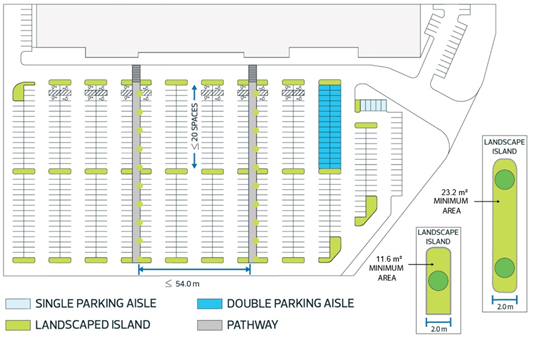
(f) At grade parking lots with 25 or more parking stalls shall provide landscaped islands:
i. at the end of each row of parking; and,
ii. after a maximum of 20 parking stalls in a parking row.
(g) To ensure the vitality of trees required in Part 5 Section 5.27.9 (i) below, a landscaped island must have a minimum width of 2.0m and;
i. a minimum area of 11.6sq m where at the end of or within a single parking row; or
ii. a minimum area of 23.2sq m where at the end of or within a double parking row.
(h) Trees planted in landscaped islands shall have a minimum rate of one (1) tree for every 11.6sq m of landscaped island. For landscaped islands greater than 23.2sq m one additional tree will be required for each additional 23.2sq m of landscaped island.
(i) Trees planted in landscaped islands shall have a minimum canopy spread of 5.0m at maturity. Landscaped islands may include shrubs and/or ground cover if approved by the Development Authority.
(j) Trees planted in landscaped islands shall have a minimum rate of one (1) tree per every nine (9) linear metres. Closer spacing may be allowed at the discretion of the Development Authority.
(k) Landscaped medians shall have a minimum of one (1) deciduous tree per every ten (10) linear metres.
5.27.10. Landscaping in Residential Districts
(a) Landscaping in urban residential districts and rural residential districts shall be in accordance with the requirements of the district.
(b) Where landscaping is required for residential development, the number of trees and shrubs provided are determined by the following ratio:
i. one (1) tree for every 35.0sq m of any required soft landscaping area and one (1) shrub for every 25.0sq m of any required soft landscaping area; and,
ii. if landscaping is used as a visual screen, noise attenuation measure, or top of bank setback, the amount of soft landscaping may be increased at the discretion of the Development Authority.
5.27.11. Landscaping in Hamlet Community Core Districts, Commercial Districts, Institutional Districts and Urban Industrial Districts
(a) Non-permeable surfacing shall be enhanced with soft landscaping as required by the Development Authority.
(b) In commercial districts, institutional districts and industrial districts in the Urban Service Area and in the Hamlet Community Core District, all plantings shall be installed to finished grade. Planters may be used at the discretion of the Development Authority. Where used, planters shall be of adequate design, having sufficient soil capacity and insulation to sustain plant material.
(c) Where an industrial district abuts any other district, a 2.0m landscaped buffer is required from the shared lot line within the industrial parcel.
(d) Additional landscaping above the district minimum may be required where the Development Authority deems it necessary to mitigate the impact of a new development.
(e) For non-residential developments, the number of trees and shrubs are determined by the following ratio:
i. one (1) tree and one (1) shrub for each 25.0sq m of any required soft landscaping area; and,
ii. if landscaping is used as a visual screen, noise attenuation measure, or top of bank setback, the amount of soft landscaping may be increased at the discretion of the Development Authority.
5.27.12. FireSmart Landscaping Regulations
(a) To reduce the threat of wildfire, the following measures shall be required in Hamlet Community Core Districts, commercial districts, institutional districts, industrial districts and in urban residential districts and rural residential districts for:
i. Apartment;
ii. Multi-Unit Development; and,
iii. Multi-Residential Development.
(b) Woody shrubs, trees or other similar plant materials shall not be located within 1.5m of the principal building.
(c) Surface material within 1.5m of the principal building and accessory buildings shall be non-combustible. Non-combustible materials may include but are not limited to gravel, soil, concrete and maintained lawns.
(d) Only fire-resistant deciduous shrubs, trees and perennials shall be planted within 10.0m of the principal building.
(e) Bark or wood mulch shall not be located within 10.0m of the principal building.
(f) Subject to Part 5 Section 5.27.12 (d) above, evergreen trees may be planted individually or among deciduous trees within 30.0m of the principal building.
(g) Coniferous trees shall be planted no closer than 3.0m from any other coniferous tree based on expected mature spread.
(h) Coniferous trees greater than 6.0m tall shall have their limbs pruned up to 2.0m from the ground.
5.27.13. Bear Smart Landscaping Regulations
(a) To reduce the amount of bear attractants in new developments within 150.0m of natural areas, the following measures apply to Hamlet Community Core Districts, commercial districts, institutional districts, industrial districts and in urban residential districts and rural residential districts for:
i. Apartment;
ii. Multi-Unit Development; and,
iii. Multi-Residential Development.
(b) Fruit and berry producing shrubs, or clover seed mixes shall not be planted.
(c) Bear proof garbage bins shall be used.
5.28. Lighting
5.28.1. Outdoor lighting shall be positioned and directed so that the light generated:
(a) does not project directly into an adjacent parcel;
(b) does not adversely affect an adjacent parcel in the opinion of the Development Authority; and,
(c) does not adversely affect traffic safety in the opinion of the Development Authority.
5.29. Liquor Store
5.29.1. A parcel containing a liquor store in the Urban Service Area shall be located 100m away from the boundary of a parcel containing another liquor store.
5.30. Live-Work Unit
5.30.1. There shall not be more than two non-resident employees in the development at any time.
5.30.2. The non-residential use shall not exceed fifty percent (50%) of the gross floor area of the live-work unit.
5.30.3. Activity from the live-work unit which generates noise levels, dust, odours, emissions, glare, radiation or vibration incompatible with and impacting adjacent uses is prohibited.
5.30.4. No outdoor storage relating to the live-work unit shall be permitted.
5.30.5. The work use shall be located on the ground floor.
5.30.6. The residential use and the commercial use of the live-work unit shall not be legally separated through a subdivision or condominium conversion.
5.30.7. The work use shall be conducted entirely indoors and shall not be undertaken in any attached garage space necessary for required parking.
5.30.8. There shall be access between the dwelling unit and the work components of the live-work unit.
5.30.9. The following uses or activities, shall not be allowed as live-work unit uses:
(a) adult entertainment facility;
(b) animal care services, major and animal care services, minor (discretionary in rural areas);
(c) automotive and equipment repair and services (discretionary in rural areas);
(d) contractor, general (discretionary in rural areas);
(e) dry cleaning establishments;
(f) fleet service and vehicle dispatch services; and
(g) industrial vehicle and heavy equipment sales, rental and storage (discretionary in rural areas).
5.30.10. A live-work unit shall not be developed in the same dwelling as a bed and breakfast, boarding house, secondary suite, child care facility, or home business, major.
5.31. Natural Resource Extraction
5.31.1. Oil Sands Mining, Extraction and Upgrading
(a) Subject to receipt of the information described in Part 5 Section 5.31.2 (a) below, the Development Authority shall approve the application to the extent that it complies with the provincial license, permit, approval or other authorization in accordance with the provisions of the Act.
5.31.2. Other Natural Resource Extraction Activities
(a) An application for a development permit for natural resource extraction shall require:
i. a disposition;
ii. location and area of the site affected by the development;
iii. the expected life of the development;
iv. the condition in which the site is to be left when the operation is complete, including the action which is to be taken for restoring the site to its original, or similar, state.
(b) The applicant shall keep the area subject to the development permit in a clean and tidy condition and free from debris.
(c) All operations shall be in accordance with all provincial legislation respecting conservation and reclamation.
(d) A disturbed area shall be reclaimed to a land capability equivalent to the pre-disturbance land capability or a post-disturbance condition and land use satisfactory to the Development Authority.
(e) Sand, gravel, and commercial logging operations shall not be permitted within 800m of an existing country residential district, hamlet boundary, or the Urban Service Area. The clearing and logging of development sites are exempt from this provision.
(f) One (1) security suite, or more as required by the operation based on demonstrated need, may be permitted for each extraction operation.
5.32. Objects Prohibited in Yards
5.32.1. No person shall keep an object which, in the opinion of the Development Authority, is unsafe, unsightly or adversely affects the amenities of the district. Including, but not limited to, dismantled or wrecked motor vehicles, stockpiling or storage of explosives, flammable liquids, diesel fuels or gasoline products.
5.32.2. No person shall keep or otherwise store building or construction materials on a parcel unless;
(a) the parcel has been approved for such use;
(b) such materials are being actively used for the purposes of an approved and released development permit; or
(c) such materials are associated with a project addressed by Part 3 Section 3.2 of this Bylaw.
5.32.3. Except as otherwise permitted under this section, no motor vehicle other than a passenger vehicle, recreational vehicle and/or one (1) commercial vehicle having a gross vehicle weight of more than 3,000kg but less than 7,000kg shall be parked on a parcel in a residential district for longer than 48 hours.
5.32.4. A maximum of one (1) recreational vehicle and one (1) utility trailer or a maximum of two (2) utility trailers may be kept on a residential parcel provided it meets setback requirements for accessory buildings in that district unless otherwise authorized by the Development Authority.
5.32.5. Despite Section 5.32.4, in rural residential districts, a maximum of one (1) recreational vehicle may be kept on a parcel. In addition, up to three (3) utility trailers may be allowed for the first 0.809ha, and an additional utility trailer may be allowed, subject to it being screened from the road, for every additional 0.809ha of lot area, up to a maximum of twenty (20) utility trailers.
5.32.6. On a residential parcel in the Urban Service Area, a recreational vehicle or utility trailer may be parked in the front yard or, in the case of a corner parcel in the exterior side yard, as long as the recreational vehicle or utility trailer:
(a) remains entirely within the parcel;
(b) is not within the corner visibility triangle;
(c) is setback a minimum of 1.0m from a side or rear lot line; and
(d) is parked on a paved or concrete driveway.
5.32.7. A recreational vehicle shall not be used for living or sleeping accommodation when on a residential parcel.
5.32.8. On residential parcels in the hamlets of Conklin, Janvier, and Fort Chipewyan, up to two (2) dismantled or wrecked vehicles may be stored in a rear yard provided that the vehicles are, in the opinion of the Development Authority, adequately screened from view and are not unsafe.
5.32.9. A motor vehicle shall not be parked in a front yard except on an approved driveway.
5.33. Project Accommodation
5.33.1. All project accommodations require a development permit.
5.33.2. A development permit for a project accommodation may be issued for up to a maximum of five (5) years, at which time an application may be made for a one-time continuance of the use for up to five (5) years, after which a new development permit approval is required.
5.33.3. An application for a development permit for a project accommodation shall provide the following information:
(a) the location, type and purpose of the camp;
(b) adjacent land uses;
(c) the method of supplying water, and sewage and waste disposal to the camp. The proposed method of sewage disposal shall comply with the Alberta Private Sewage Treatment and Disposal Regulation and be to the satisfaction of the Regional Health Authority;
(d) the number of persons proposed to live in the camp;
(e) the MLL (miscellaneous lease) number issued by the relevant authority;
(f) the start date for development, date of occupancy by residents, and removal date for the camp; and,
(g) reclamation measures once the camp is no longer needed, at the discretion of the Development Authority.
5.33.4. An extension under Part 5 Section 5.33.2 requires that, to the satisfaction of the Development Authority:
(a) An application be submitted prior to the expiration of the existing approved development permit containing the following information:
i. current certificate of title or land dispositions/lease documents issued by the owner/authority;
ii. site plan;
iii. floor plans;
iv. servicing plans; and,
v. current emergency management plan.
(b) Development permit fees are paid.
(c) Reporting as set out in Part 5 Section 5.33.5 is compliant.
(d) Development permits, including revisions, are current and approved as of the date of the requested extension, including without limitation any change to site plans, servicing plans, bed counts and floor plans as required.
5.33.5. As a condition of any approval for a project accommodation, the development permit applicant is required to submit the following information annually on or before January 31st:
(a) updated or as-built site plan on the date of reporting;
(b) existing bed count and current occupancy; and,
(c) changes to the facility name, operation, services, or contact details.
5.33.6. In cases where the applicant or owner fails to submit the annual updates required in accordance with Part 5 Section 5.33.5, the Development Authority may, at its discretion:
(a) refuse to issue an extension of an approved development permit;
(b) begin enforcement action against the applicant if the project accommodation is found to be non-compliant with the conditions of the existing approved development permit.
5.33.7. The applicant must inform the Development Authority in writing about the removal of a project accommodation a minimum of 30 days prior to the expiration of the existing development permit(s) for such use.
5.33.8. The applicant must apply for a new development permit, or an extension of an existing development permit, for a project accommodation a minimum of 30 days prior to the expiration of an existing development permit(s) for such use.
5.33.9. An approved development permit for a project accommodation of 499 beds or less, may be extended a further 120 days to allow for decommissioning. The project accommodation shall be unoccupied commencing on the expiry date of such development permit and all facilities associated with such use removed from the site within 120 days of such expiry date.
5.33.10. In addition to meeting the requirements of Part 5 Section 5.33.9, project accommodations of 500 beds or greater shall obtain a demolition permit if the decommissioning period is to be longer than 120 days from the date of the expiry of the development permit. The term of the demolition permit will be established at the discretion of the Development Authority based on the submission of a decommissioning plan by the applicant.
5.33.11. The decommissioning requirements of Part 5 Section 5.33.9 or Part 5 Section 5.33.10 shall not apply, if, in the opinion of the Development Authority, the applicant has submitted an application and is working with the Development Authority on either a new development permit or an extension of an existing development permit.
5.34. Projections into Setback Areas
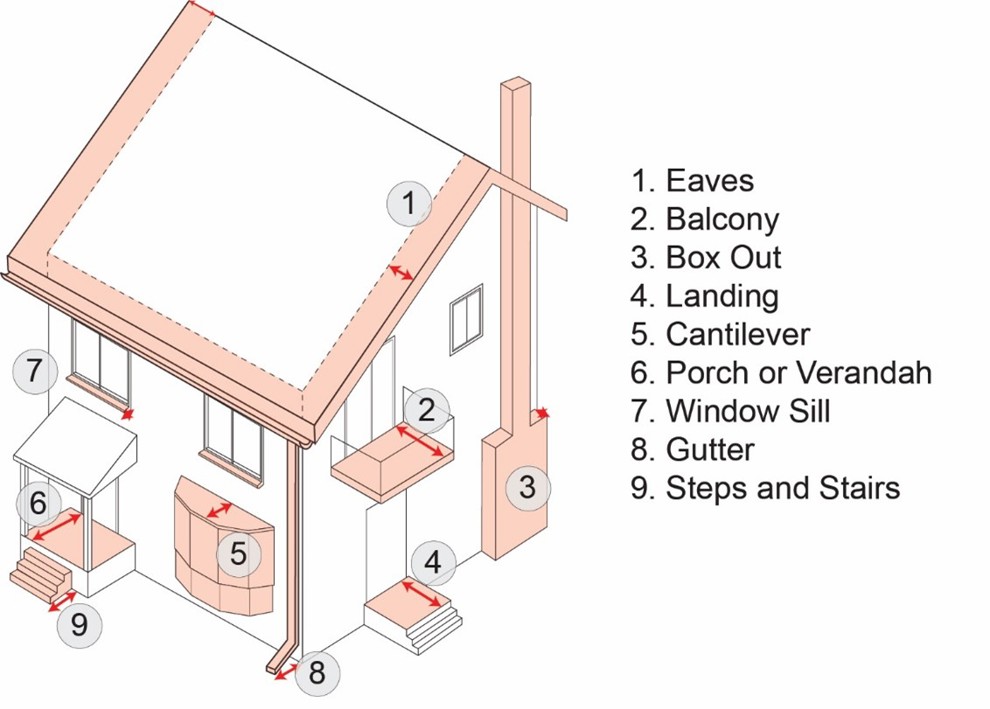
5.34.1. The following projections into required front, side and rear yard setbacks in land use districts may be permitted (see Figure 5.2 Projections into Setback Areas):
(a) Front and rear yard:
i. 2.0m for balconies; and,
ii. 1.0m for cantilevers, eaves, eavestrough, landings, window sills, steps and stairs, boxouts and verandahs.
(b) Interior side yard:
i. 0.6m for boxouts, eaves, eavestrough, landings, window sills, steps and stairs and verandahs; and,
ii. Boxouts shall be limited to a maximum number of one (1) per building face and have a maximum width of 2.0m.
(c) Exterior side yard:
i. 0.9m for landings;
ii. 0.6m for boxouts, cantilevers, eaves, eavestrough, landings, window sills and steps and stairs; and,
iii. Boxouts shall have a maximum width of 2.0m.
5.34.2. In the case of a zero lot line development, balconies may be extended to the lot line or common wall, provided that the common wall is extended for separation or privacy.
5.34.3. No projections will be permitted if, in the opinion of the Development Authority, it may interfere with a loading space, parking area, driveway, pedestrian circulation and/or other vehicle circulation or access.
5.34.4. No portion of the building foundation is permitted to encroach into a minimum required setback.
5.34.5. No projections will be permitted into a side yard that is required for vehicular access to a rear yard, unless a minimum vertical height of 4.0m from finished grade to the lowest point of the projection is maintained.
5.35. Relocation of Buildings
5.35.1. Except as otherwise provided for in this Bylaw, no person shall relocate to a parcel a building or structure, or portion thereof, without first obtaining a development permit for the relocated building or structure.
5.35.2. Excepting an accessory building, a relocated building or structure shall be considered a discretionary use in all districts.
5.35.3. A development permit for the relocation of a building or structure shall, in addition to any other development permit requirement, include a safety plan and an access, traffic and pedestrian plan.
5.36. Renewable Energy Devices
5.36.1. Where a renewable energy device is mounted on a roof of a building, it may extend above the permitted maximum height for the district by 1.5m.
5.36.2. Wind farm/solar collector farm require a development permit and shall comply with the following:
(a) shall be setback 550.0m from any residential district;
(b) shall have a maximum height of 15.0m above the maximum building height of the district;
(c) shall be painted a single, neutral, non-reflective, non-glossy colour, to the extent possible, which visually blends the system with the surrounding natural and built environments;
(d) shall not contain any accent lighting, or be indirectly illuminated or artificially lit, except as required for navigational safety;
(e) shall not contain any signs other than directional signs; and,
(f) shall not be within 100.0m of any permanent or temporary wetland or water body.
5.37. Secondary Suite
5.37.1. A maximum of one secondary suite may be permitted per principal dwelling.
5.37.2. Secondary suites shall only be allowed as an accessory use to a mobile home, single detached dwelling, and semi-detached dwelling.
5.37.3. A secondary suite shall not be developed in the same property containing a boarding house, bed and breakfast, child care facility, live-work unit, and home business, major.
5.37.4. A secondary suite shall be limited to a maximum of two (2) sleeping units.
5.37.5. Secondary suites shall comply with the standards provided as follows:
| Standard | Basement Suite and Loft Suite | Attached Suite | Detached Garage Suite | Garden Suite |
| Lot area (minimum) | 365.0sq m | 365.0sq m | 500.0sq m | 500.0sq m |
| Setbacks (minimum) | N/A | As per district requirements | Same as accessory buildings | Same as accessory buildings |
| Height (maximum) | As per district requirements | As per district requirements | 7.6m or the height of the principal dwelling, whichever is lesser | 7.6m or the height of the principal dwelling, whichever is lesser |
5.37.6. The parking space for the suite shall be connected to the suite by an unobstructed hard-surface walkway (e.g. concrete, paving stones, concrete slabs) which is a minimum of 1.0m wide.
5.37.7. Design Considerations for a detached garage suite or garden suite:
(a) Entrance to the secondary suite shall be separate from the vehicle entrance to the detached garage, either from a common indoor landing or directly from the exterior.
(b) Windows shall be located and sized to minimize overlook into the private amenity area of abutting parcels.
(c) Windows shall be off-set to limit direct views of an abutting dwelling unit window.
5.37.8. The access to the attached suite, basement suite or a loft suite shall be separate and shall not pass through any portion of the principal dwelling unit and/or an attached garage at the ground floor level.
5.38. Security Suites
5.38.1. A security suite is a discretionary use and is accessory to the principal use.
5.38.2. Only one (1) security suite shall be permitted per parcel.
5.38.3. The maximum gross floor area of a security suite shall not exceed 70.0sq m.
5.38.4. A security suite requires one (1) parking stall.
5.38.5. A security suite shall not be located in a recreational vehicle.
5.39. Service Station
5.39.1. A service station:
(a) shall provide lighting that is fully recessed where there is a canopy;
(b) may include an outdoor display of products related to the use and shall be located adjacent to the building entrance or on gas pump islands;
(c) shall locate all pump islands a minimum of 15.0m away from any residential use.
5.40. Setbacks from Highways
5.40.1. The provisions of this section shall not apply to development within the CBD1 – Central Business District.
5.40.2. A minimum building setback of 40.0m is required from the existing right-of-way of a highway except:
(a) where a service road has been provided, the building setback may be reduced to 10.0m; or,
(b) unless otherwise approved by the Development Authority.
5.41. Site Layout
5.41.1. The layout of the site, structures, and parking areas shall facilitate the movement of pedestrian and vehicle traffic through the use of safe barriers such as landscaping, separated walkways and raised crosswalks.
5.41.2. For buildings larger than 2,000.0sq m the developer shall provide a sidewalk from the building doors to the nearest drive aisle, for the length of that drive aisle.
5.41.3. Pedestrian access to all sites, except residential sites with less than ten (10) units, shall be provided by a sidewalk system connecting from the adjacent public sidewalk to the front doors of each building on site. The sidewalk systems shall have the following features:
(a) The sidewalk shall be at least 1.5m in width and barrier free. No portion of a parking stall, including the vehicle overhang, shall be included in the 1.5m width.
(b) The sidewalk shall be hard-surfaced and graded with a maximum slope of six percent (6%). No steps are permitted, but if included in the path of travel, shall be accessible to accommodate all users including people with disabilities or using a mobility device.
(c) For sites that have a frontage greater than 30.0m the sidewalk system shall connect to the existing public sidewalks or connect directly to sidewalk systems on adjacent sites.
(d) Townhouse developments do not need an additional sidewalk to each unit.
5.42. Special Events
5.42.1. The Development Authority shall consider, but is not limited to, the following factors in making its decision on a special event:
(a) the siting;
(b) the location, size and height of any buildings, including signs;
(c) the location and use of outdoor speakers and amplification systems having regard to adjacent uses;
(d) screening and buffering;
(e) hours of operation; and
(f) the adjacent property owner’s notification comments.
5.42.2. Special events are subject to notice posting notification.
5.42.3. Where a building is erected as part of a special event:
(a) the lot coverage and floor area ratio of the district shall not apply.
5.42.4. A special event shall:
(a) be returned to its original pre-special event condition after the conclusion of the special event, including but not limited to the removal of all buildings erected as part of the special event;
(b) provide the parking for the special event as determined by a parking plan, to the satisfaction of the Development Authority; and,
(c) accommodate parking on the subject parcel of land or on a separate parcel of land located a maximum of 200.0m from the subject parcel.
5.42.5. The duration of a special event shall:
(a) not exceed:
i. fifteen (15) consecutive days, and,
ii. eighteen (18) days total in one (1) calendar year;
(b) exclude any time needed to set-up and take-down the special event, provided that such activity shall not exceed a maximum of ten (10) days total. The Development Authority may allow additional time for such activity, at its discretion.
5.42.6. The Development Authority may approve a special event of longer duration if satisfied the special event is compatible with the character of the area and other uses located on, or abutting, the parcel.
5.42.7. The Development Authority may have as conditions of a development permit for a special event any or all of the following:
(a) limiting the hours of operation;
(b) requiring parking and its location;
(c) requiring police, EMS, and fire services to be provided at, or as a result of, the special event;
(d) mitigating measures for any potential health and safety risks;
(e) mitigating potential nuisance factors, including but not limited to, pollution, noise, dust, traffic congestion, garbage disposal, and recycling; and,
(f) any other conditions, in the opinion of the Development Authority, that may be necessary.
5.42.8. A development permit shall not be issued for a special event within 100.0m from the boundary of a parcel of any urban residential district or rural residential district.
5.42.9. Despite Part 5 Section 5.42.8, a development permit for a special event may be issued within 100.0m of a rural residential district if the special event is to be held in a HCC – Hamlet Community Core District.
5.43. Weather Protection
5.43.1. Other than for single detached dwelling, semi-detached dwelling, duplex, or multi-unit dwelling uses, building elements for weather protection, including but not limited to, recessed building entrances, awnings and canopies, all with a minimum depth of 1.5m, shall be provided adjacent to building entrances, at the discretion of the Development Authority.
(a) In the case of buildings with commercial uses at the ground floor, awnings or canopies shall be provided for a minimum of eighty (80%) percent of the length of the façade having the primary building entrance;
i. Awnings or canopies shall provide a clearance of not less than 2.5m above grade.